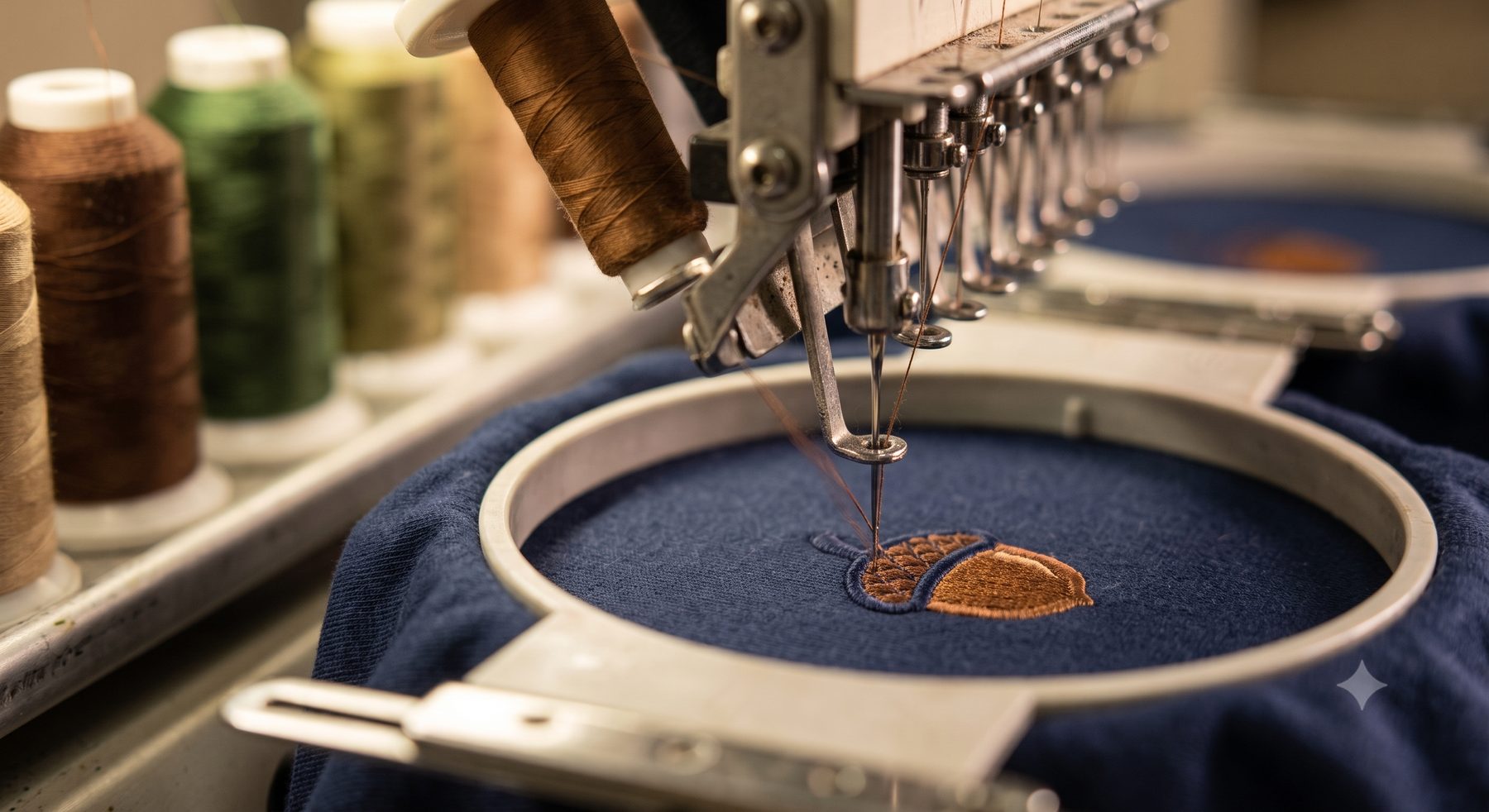
Custom Embroidery in Rhode Island
Embroidery is where East Coast Embroidery started in 1986, and it's still the core of what we do — stitched logos on polos, jackets, hats, and uniforms that hold up for years, not weeks.
What Is Custom Embroidery?
Short answer: embroidery stitches your logo directly into the fabric using thread, rather than printing or pressing it onto the surface. That's what makes it the most durable decoration method — there's no ink or vinyl to crack, peel, or fade.
A digital embroidery machine reads a stitch file — a digitized version of your logo — and sews it into the garment thread by thread, building up color and detail the same way hand embroidery does, just faster and more precisely. Because the design becomes part of the fabric's structure, it survives washing, drying, and years of regular wear in a way that printed decoration generally can't match.
It's the standard choice for anything worn regularly and laundered often: polos, quarter-zips, jackets, uniforms, and hats where a logo needs to represent the business every single time someone sees it.
How Our Embroidery Process Works
Four steps, two weeks, done — with a physical stitch sample on every new logo before we run your full order.
- Digitizing. If your logo is new to us, we convert your artwork into a stitch file — the machine-readable instructions that control stitch type, direction, and density. Vector files (.AI, .EPS, vector PDF) digitize most cleanly; we can rebuild a logo from a PNG or JPG if that's what you have.
- Stitch sample. Every new embroidery file gets stitched onto a physical sample of test fabric before we touch your actual order. You see exactly how it looks and stitches before we commit to your garments.
- Approval & production. Once you sign off on the sample, we run your full order — typically two weeks or less from approval.
- Reorder anytime. Your digitized file stays on file permanently. Every reorder after the first skips the digitizing fee entirely and uses the exact same stitch file.
What We Embroider
Embroidery works best on stable, medium-to-heavyweight fabrics that can support stitching without puckering. Common requests include:
- Polos & knit shirts — the most common corporate and uniform request, left-chest placement
- Jackets & outerwear — quarter-zips, softshells, fleece; left chest or full back
- Hats & caps — see our dedicated hat decoration process for structured/unstructured caps and 3D puff
- Uniform programs — scrubs, work shirts, coveralls, with consistent placement across a whole team
- Bags & accessories — totes, backpacks, and similar structured goods
Very lightweight or high-stretch performance fabrics can pucker under dense stitching — if you're decorating technical/performance wear, ask us about backing options or whether laser etching might be a better fit.
Thread & Color Matching
Short answer: we match your brand colors using Pantone (PMS) references, primarily with polyester thread — the industry-standard choice for commercial embroidery because it holds color and resists fading through repeated washing.
We stitch primarily in polyester thread for corporate and uniform work — it's more colorfast and bleach-resistant than rayon, which makes it the more practical choice for apparel that gets washed regularly. Rayon thread has a natural sheen that some brands prefer for a more premium or vintage look on lower-wash-frequency pieces; we can discuss which fits your project.
Either way, we reference your Pantone (PMS) codes against our thread library to get as close a match to your brand colors as the medium allows. Don't have your PMS codes handy? Send your logo file or brand style guide and we'll identify them.
Digitizing & What Drives the Cost
Short answer: a one-time digitizing fee applies to new logos. After that, cost is driven mainly by stitch count (how detailed the design is) and quantity — not a flat per-shirt rate.
Digitizing is design work, not just file conversion — it determines stitch type, direction, and density to make sure your logo actually looks right once it's sewn rather than just scaled down from a print file. That's why it's a one-time fee rather than something bundled into every order: once it's done and stitches correctly, that same file runs every future order without repeating the work.
From there, the main cost driver is stitch count. A simple text logo or a clean one-color mark stitches (and prices) very differently than a dense, highly detailed multi-color design. Larger quantities bring the per-piece price down since the digitizing cost is already covered. For the full picture on how pricing works across all our decoration methods, see our pricing guide.
Durability & Care
Properly cared-for embroidery holds up for years. A few things that help it last even longer:
- Turn garments inside out before washing to reduce surface friction on the stitching
- Wash in cold water when possible — heat is harder on both thread and garment fabric over time
- Avoid ironing directly on embroidered areas; iron from the inside out, or use a pressing cloth
- Skip the bleach — polyester thread resists fading, but bleach isn't necessary and can affect surrounding fabric
Embroidery vs. Other Methods
Embroidery isn't the right call for every project — full-color photo-quality graphics or very large single-run event shirts are often better served by screen printing or heat press transfer. See our full breakdown in Embroidery vs. Screen Printing vs. DTF, or browse all six decoration methods on our Services page.
Compare With Other Methods
Frequently Asked Questions
What's the smallest logo size you can embroider?
Can you embroider on leather, vinyl, or hats?
Can you add names or numbers alongside a logo?
Do you offer 3D puff embroidery?
Is there a digitizing fee for new logos?
Can I supply my own blank garments?
Ready to embroider your logo?
Send us your garment, quantity, and logo — we'll take it from there.
Get a Quote